We use cookies to make your experience better. To comply with the new e-Privacy directive, we need to ask for your consent to set the cookies. Learn more.



Sadiq Khan Calls for decriminalization of cannabis possession

Age Verification
Please confirm you are over 18 to visit this website
-
May 30, 2025
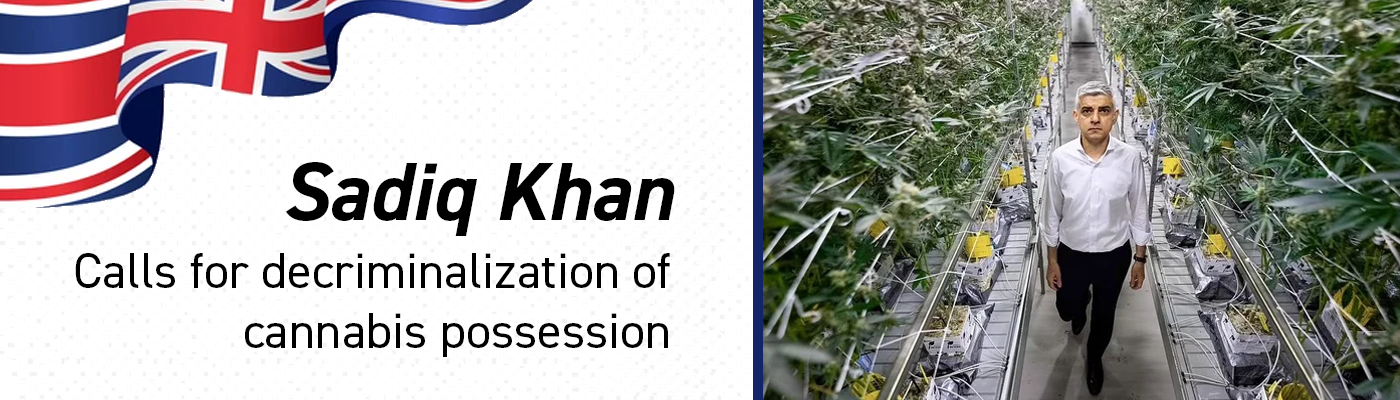
London Mayor Sadiq Khan recently endorsed partial de-decriminalization for cannabis possession, which, if followed through with at a party level, would mark a significant shift in the UK's drug policy, but at least at this point, it stands as a stark contrast to the typical political discourse regarding Cannabis. While this move aims to address certain systemic issues, it falls short of tackling the broader challenges faced by medical cannabis patients, both those who consume black market cannabis and legal Cannabis for medical benefits, and the inconsistencies within the current regulatory framework.
Sadiq Khan's Proposal: A Step Forward?
In May 2025, Mayor Khan backed the London Drugs Commission's recommendation to decriminalize the possession of small quantities of natural Cannabis for personal use. The commission, led by former Justice Secretary Lord Falconer, highlighted the disproportionate impact of current cannabis laws on ethnic communities and advocated for treating possession under the Psychoactive Substances Act rather than the Misuse of Drugs Act.
Khan emphasized the need for a refreshed approach to drug policy, focusing on education, healthcare, and fairer policing practices. He pointed to global evidence supporting reform, including California's regulated cannabis market, as a model for potential benefits in public health and tax revenues. One thing they completely fail to mention is the current medical cannabis availability in the UK and how it is widely available for nearly all chronic conditions privately, simply as a second-line or third-line treatment. This has led to a two-tier system where some people can possess cannabis flowers legally and others can't; essentially, it all comes down to taxation and government licenses.
The Limitations of Decriminalisation
Despite its progressive intent, decriminalization addresses only a fraction of the issues surrounding cannabis use in the UK. It does not resolve the challenges faced by medical cannabis patients, who often struggle with access, affordability, quality and resulting discrimination in a country with limited medical awareness.
Since the legalization of cannabis-based medicinal products (CBMPs) in 2018, approximately 40,000 patients have received these treatments through private clinics. However, NHS prescriptions remain scarce, with only a handful issued outside of specific criteria.
Consequently, an estimated 1.8 million individuals resort to the illegal cannabis market to alleviate health conditions, spending around £3.57 billion annually. This reliance on unregulated sources purportedly leads to significant health risks. However, this is necessitated by the criminalization of Cannabis. If home growth were allowed, true quality would clearly stand out amongst the vast majority of profit-driven corporations that only care about the bottom line.
The 'Grow Your Own' Petition: A Missed Opportunity
In response to these challenges, a petition was submitted to the UK government, advocating for legal medical cannabis patients to cultivate their own plants. The proposal suggested allowing patients to maintain 3–6 flowering plants with oversight mechanisms similar to those in Canada.
The government's response, however, was dismissive. They argued that homegrown Cannabis is not a safe or appropriate substitute for regulated CBMPs and have no plans to change the law to permit its use. This stance overlooks the financial burdens faced by patients and the potential benefits of home cultivation permission for legal patients . Cannabis Law Report+1Petitions - UK Government and Parliament+1.
The Two-Tiered System: Legal vs. Illegal Access
The UK's current approach has inadvertently created a two-tiered system. On one hand, a limited number of patients access expensive, imported medical Cannabis through private clinics. On the other, a vast majority rely on the black market, risking legal repercussions and health complications if grown by gangs whose only motivation is profit.
This dichotomy is further exacerbated by the government's insistence that cannabis companies self-fund studies to achieve National Institute for Health and Care Excellence (NICE) approval. The NHS as funded by tax, will not pay anything close to the current prices they receieve privately. So how does it make any sense that these companies will invest in research to get paid less. That doesn't work for a business; that works for individual philanthropists. It is like the government has forgotten that capitalism exists.
The Need for Comprehensive Reform

To address these systemic issues, the UK must consider a more holistic approach:
- Facilitate Home Cultivation: Implement a regulated system allowing medical cannabis patients to grow their own plants, reducing reliance on the black market.
- Increase NHS Accessibility: Streamline the process for obtaining NHS prescriptions for medical Cannabis, ensuring equitable access for all patients.
- Support Research Funding: Provide government-backed funding for studies on medical Cannabis instead of placing the onus on private companies and accelerating the path to NICE approval.
- Educate Healthcare Professionals: Incorporate comprehensive training on the endocannabinoid system and medical Cannabis into medical education, reducing stigma and improving patient care.
Conclusion
While Sadiq Khan's proposal to decriminalize cannabis possession is a commendable step towards reform, it fails to address the deeper, systemic issues plaguing medical cannabis access in the UK. A more comprehensive strategy, encompassing legal, medical, and educational reforms, is essential to ensure that all patients receive the care they need without undue hardship or legal risk.
Recent Posts
-
New Arrivals from Night Owl Seeds: The Banana OG Collection Has Landed
 July 14, 2026
 -
New Perfect Tree Cannabis Seeds Arrive at Pure Sativa: Peach Moon Cake, Chillatozz, Bananozz & Venice Peach
 July 10, 2026
 -
Puffco Plasma Collection Drops Today at Pure Sativa: Peak Pro 3DXL Device, 3DXL Chamber & Hot Knife
 July 8, 2026
 -
RipTip Review: Premium Reusable Glass Tips at Pure Sativa
 July 7, 2026
 -
New Archive Seedbank Strains at Pure Sativa: 8 Regular Seeds Now Available
 July 3, 2026